How to Get the Best Blood Pressure Reading
How to use a habitation blood pressure monitor
-
Be still. Don't fume, beverage caffeinated beverages or practise inside thirty minutes earlier measuring your blood pressure. Empty your float and ensure at to the lowest degree 5 minutes of quiet rest before measurements.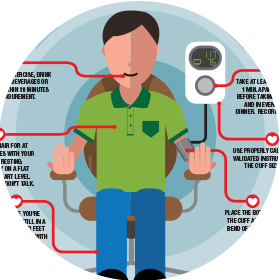
- Sit down correctly. Sit down with your back straight and supported (on a dining chair, rather than a sofa). Your feet should be flat on the flooring and your legs should not be crossed. Your arm should be supported on a flat surface (such as a table) with the upper arm at eye level. Make sure the bottom of the gage is placed directly above the curve of the elbow. Check your monitor'south instructions for an illustration or have your healthcare provider show you how.
- Measure at the same fourth dimension every day. It's important to take the readings at the same time each day, such as morning and evening. It is all-time to take the readings daily notwithstanding ideally beginning 2 weeks afterward a change in treatment and during the week before your next engagement.
- Accept multiple readings and record the results. Each time you measure, have ii or iii readings 1 minute apart and record the results using a printable (PDF) tracker. If your monitor has built-in memory to store your readings, take information technology with you lot to your appointments. Some monitors may also allow yous to upload your readings to a secure website afterwards you annals your profile.
- Don't take the measurement over clothes.
Download a PDF sheet that shows you how to measure your blood pressure level properly. Likewise bachelor in Spanish and Chinese.
Know your numbers
Learn what the numbers in your claret pressure reading mean.
| BLOOD Force per unit area CATEGORY | SYSTOLIC mm Hg (upper number) | and/or | DIASTOLIC mm Hg (lower number) |
|---|---|---|---|
| NORMAL | LESS THAN 120 | and | LESS THAN 80 |
| ELEVATED | 120 – 129 | and | LESS THAN 80 |
| Loftier BLOOD PRESSURE (HYPERTENSION) STAGE 1 | 130 – 139 | or | eighty – 89 |
| High Claret PRESSURE (HYPERTENSION) STAGE ii | 140 OR Higher | or | 90 OR HIGHER |
| HYPERTENSIVE CRISIS (consult your doctor immediately) | College THAN 180 | and/or | HIGHER THAN 120 |
Annotation: A diagnosis of high blood pressure must be confirmed with a medical professional person. A doctor should also evaluate any unusually low claret pressure readings.
Download this chart: English language Jpeg | English PDF | Spanish Jpeg | Spanish PDF | Traditional Chinese Jpeg | Traditional Chinese (PDF)
If y'all go a high blood pressure reading
- A unmarried high reading is not an firsthand crusade for alarm. If you get a reading that is slightly or moderately higher than normal, take your blood pressure level a few more times and consult your healthcare professional to verify if there' due south a health concern or whether at that place may exist any issues with your monitor.
- If your claret pressure readings all of a sudden exceed 180/120 mm Hg, wait five minutes and test over again. If your readings are still unusually loftier, contact your md immediately. You could be experiencing a hypertensive crisis.
- If your blood pressure is higher than 180/120 mm Hg and you are experiencing signs of possible organ impairment such every bit chest pain, shortness of breath, back hurting, numbness/weakness, change in vision, difficulty speaking, do non await to see if your pressure level comes down on its own. Call 911.
AHA Recommendation
The American Heart Association recommends home monitoring for all people with high blood pressure to help the healthcare provider determine whether treatments are working. Home monitoring (cocky-measured blood pressure level) is not a substitute for regular visits to your physician. If yous have been prescribed medication to lower your claret pressure, don't cease taking your medication without consulting your doctor, fifty-fifty if your blood pressure level readings are in the normal range during domicile monitoring.
Choosing a dwelling claret pressure level monitor
The American Center Association recommends an automatic, cuff-style, bicep (upper-arm) monitor.
- Wrist and finger monitors are non recommended because they yield less reliable readings.
- Cull a monitor that has been validated. If yous are unsure, ask your doctor or chemist for communication or find options at validatebp.org(link opens in new window).
- When selecting a claret pressure monitor for a senior, significant woman or child, brand certain it is validated for these conditions.
- Make sure the cuff fits — measure around your upper arm and choose a monitor that comes with the correct size gage.
Once you've purchased your monitor, bring it to your adjacent date
Have your doctor check to meet that you are using information technology correctly and getting the same results as the equipment in the office. Plan to bring your monitor in once a year to make sure the readings are accurate.
Home blood pressure monitoring may be especially useful for:
- Anyone diagnosed with high blood pressure (HBP or hypertension).
- Individuals starting high claret force per unit area treatment to determine its effectiveness.
- People requiring closer monitoring, peculiarly individuals with risk factors for loftier blood pressure and/or weather related to high blood force per unit area.
- Pregnant women, experiencing pregnancy-induced hypertension and/or preeclampsia.
- Evaluating potentially false readings, like:
- People who simply have loftier readings at the doctor' s function ("white coat" hypertension).
- People who but have high readings at habitation only not at the doc' s office ("masked" hypertension).
- Note: People with atrial fibrillation or other arrhythmias may not be adept candidates for home monitoring considering electronic home blood pressure devices may not be able to requite accurate measurements. Inquire your doctor to recommend a monitoring method that works for you lot.
Left-arm vs. right-arm blood pressure
Several studies accept been done to determine what is a normal variation between correct and left arm. In full general, any deviation of 10 mm Hg or less is considered normal and is not a cause for concern.
Why go along a blood force per unit area journal?
I claret pressure measurement is like a snapshot. It only tells what your blood force per unit area is at that moment. A record of readings taken over time provides a "time-lapse" motion-picture show of your claret pressure that tin assistance you partner with your doctor to ensure that your treatments to lower high blood pressure (HBP or hypertension) are working.
How to Get the Best Blood Pressure Reading
Source: https://www.heart.org/en/health-topics/high-blood-pressure/understanding-blood-pressure-readings/monitoring-your-blood-pressure-at-home
0 Response to "How to Get the Best Blood Pressure Reading"
Post a Comment